


- Blog
- /
- Business Valuation: A Simplified Guide for SMEs
Business Valuation: A Simplified Guide for SMEs
Estimated Read Time: 5 Minutes
Pooja Jaiswal , 19 December, 2024
Understanding business valuation is key to SMEs’ efforts in securing funds, attracting investors, or simply planning for the future. Business valuation is a somewhat complex process that helps determine the financial worth of a company, crucial for transactions, strategic planning, and securing funding.
This guide explores valuation methods, key drivers of value, and what banks and financial institutions look for when determining whether to approve loans.
Methods of Business Valuation
One of the things that needs to be realised regarding a business valuation is that such an approach cannot be made one-size-fits-all. Different methods present individual perspectives, and all do so to point out what a business’s worth should be.
The three main methods used to determine business value are the Asset-Based Approach, Income-Based Approach, and Market-Based Approach. Each one of those mentioned above involves other methodologies that can shed light on what the financial strength and growth prospects of a company may hold.
1. Asset-Based Approach
The Asset-Based Approach adds up the value of everything your business owns, both tangible things, like buildings and equipment, and intangible things, like brands and patents. This works best for businesses that own a lot of physical things, such as factories or real estate companies.
How It Works:
The Asset-Based Approach is divided into two main methods:
- Book Value: The value calculated by a business by subtracting all its liabilities from its total assets and finding out the firm’s net worth or book value, which can be traced using its balance sheet. One might easily calculate its simple yet sometimes simplistic form where the method didn’t use the intangible and intangible potential income-generating property to reach such a conclusion.
Business Value = Total Assets − Total Liabilities
- Liquidation Value: This method gauges the amount of money one would get if the business closed and sold everything it owned. It sums up how much cash one would get from selling all your assets, then subtracts money owed to others.
Liquidation Value=Sale of Assets−Liabilities
Best For: The Asset-Based Approach is suitable for companies with massive amounts of physical assets or those with financial strains. It is also fitting for companies most likely to be liquidated or sold off-possibly distressed businesses or companies in heavy asset sectors.
Considerations: Although asset-based valuations give a highly clearer picture of the tangible worth of a business, they may just pass over the future earning ability of a company or even intangible assets, which involve intellectual property, brand values, and customer relationships. Because of this, the method is used effectively when the company is asset-heavy with the value in those tangible resources rather than when future profits are generated in itself.
2. Income-Based Approach
The Income-Based Approach focuses on the potential for future profits and cash flows in a business. This method is particularly useful for businesses that generate steady income streams and rely less on physical assets. It gives a forecast of a company’s financial performance and discounts it to get the present value.
How It Works:
The Income-Based Approach encompasses two primary methods:
- Discounted Cash Flow (DCF): This method examines how much money your business might make in the coming years. Using a discount rate, it then adjusts those future amounts to show what they’re worth today. This works best for businesses that can predict their future income fairly well.
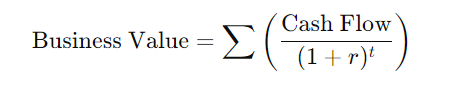
Where:
- Cash Flow = The projected future cash flow of the business.
- r = The discount rate.
- t = The time period.
- Capitalisation of Earnings: Capitalisation of Earnings: This one is a simplified version of DCF and is generally applied where earnings are relatively stable, such as businesses. One divides earnings before interest, taxes, depreciation, and amortisation (EBITDA) or net income of the projected future period by the capitalising rate calculated and used as the required rate for investment, taking cognisance of the entity’s risk.
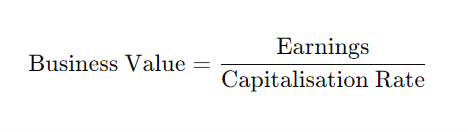
Best For: The income-based approach would be most suitable for businesses that have stable and predictable incomes, such as established companies that operate in sectors like utilities, retail, and some service industries. The approach is also commonly used for those businesses seeking long-term investment, where profitability in the future is mainly considered.
Considerations: The DCF method is highly sensitive to assumptions about future cash flows and the discount rate. Small changes in these inputs can significantly impact valuation. Additionally, forecasting future cash flows can be challenging, especially for start-ups or businesses in industries with volatile market conditions.
3. Market-Based Approach
In the Market-Based Approach, the value of a company is calculated based on prices that other similar businesses had sold for in the open market. This approach tends to be based on evidence regarding past transactions that could lead one to estimate the value of any company. It is popular among industries that have comparable firms or transactions available.
How It Works:
There are two primary methods within the Market-Based Approach:
- Comparable Company Analysis (CCA): Here, the business is comparable to companies in the industry that have been publicly traded or sold recently. To estimate the value of a target company, valuation multiples such as P/E from these companies are applied to the target company’s relevant financial metrics, including P/S, EV/EBITDA and others.

Where:
- Comparable Multiple = The multiple derived from comparable companies.
- Target Metric = The relevant financial metric of the business being valued (e.g., revenue, EBITDA).
- Precedent Transactions: In this method, one takes into account the price that has been paid to a similar company in past deals, which may include mergers and acquisitions. One then applies the multiples obtained from those deals to estimate the worth of the business under consideration.

Best For: The Market-Based Approach is commonly applied when there is a strong set of comparable data or for companies in industries with high transaction volume, such as technology, retail, or manufacturing. It is most effective when market sentiment plays a large role in determining business value.
Considerations: While market-based approaches may be valuable, they are inherently dependent on the availability and reliability of market data. In industries in which comparable companies are not prevalent, these methods are bound to be less effective. Moreover, external market conditions, as well as investor sentiment, may lead to distortions in ascertaining the true value of a business.
4. Other Approaches to Business Valuation
Rule of Thumb Valuation
The Rule of Thumb Valuation uses common industry formulas to find a business’s value by looking at important numbers like revenue or EBITDA.
Best For: Small businesses in sectors like retail or restaurants where a quick, simplified estimate is needed.
Considerations: While useful, it oversimplifies and may overlook specific operational details, so it should not be the sole method for valuation.
Real Options Valuation (ROV)
ROV analyses a company’s value by analysing potential opportunities that might impact future growth in a business. Financial modelling is applied to determine a strategic choice’s worth similar to trading options.
Best For: Highly potential and technologically evolving companies where every decision has to change the course of their business.
Considerations: Requires complex forecasting and expertise, making it challenging to apply without detailed insights into future opportunities.
Adjusted Net Asset Method
This is the modified variation of the traditional asset-based valuation approach that makes a better revision by adjusting both tangible and intangible assets like intellectual property value and brand value.
Best For: It will be very convenient when companies possess more invaluable intangible assets. Software industries, strong loyalty, or franchise businesses would be best suited here.
Considerations: Accurate appraisals are essential for assets and their associated intangibles, more cost-and-time-intensive
Sustainable Earnings Valuation
This method computes a value based on a company’s ability to sustain consistent, long-term earnings by adjusting for non-recurring items and projecting future profits.
Best For: Mature businesses with stable earnings in industries like manufacturing or utilities.
Considerations: It relies on historical data, which may not always predict future performance, especially in rapidly changing industries.
Conclusion: Leveraging Nucleus for Financial Insights and Growth
Knowing your business’s value helps you grow and get money. At Nucleus, we help small and medium businesses get the funding they need to grow. We understand your business needs and offer new ways to get funding, helping you succeed and build a stronger future.
Get in touch now to see how Nucleus can support your business goals.
